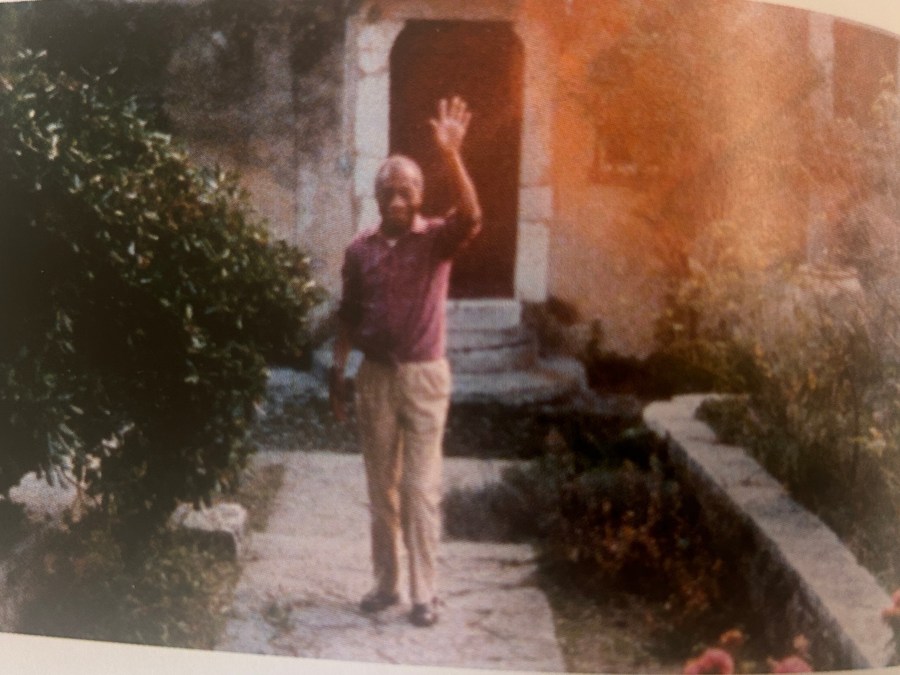
A literary pilgrimage to James Baldwin’s home in Saint-Paul-de-Vence:
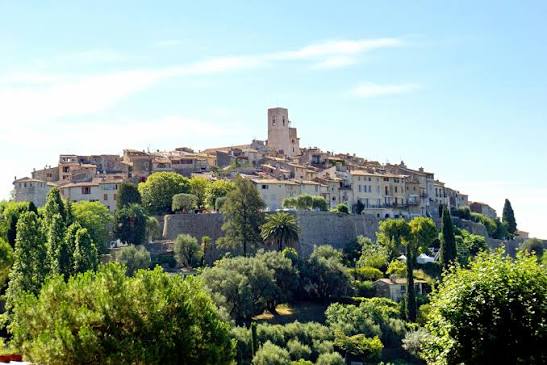
By the time we’d doubled back along yet another road, all three of us were hungry, the Provençal sun was relentless, and I was beginning to suspect that James Baldwin had deliberately made himself difficult to find.
Three parallel roads ran along the hillside beneath Saint-Paul-de-Vence. Our GPS insisted we had arrived. The tourist office map suggested otherwise. Milan, my partner, studied his phone while our friend Kimberley looked toward the distant village, where we’d recently been enjoying cold drinks beneath an umbrella.
All this to find Jimmy.
I’d spent years making literary pilgrimages to the homes of writers I admired, hoping to discover something about their lives through the places they’d inhabited. Baldwin, however, had always eluded me. Even in Paris, where I’d taught for decades, I’d encountered his presence in the city’s literary history but found few physical traces of the man himself.
Now, in the hills above the French Riviera, I hoped to find the home where he’d spent his final years.
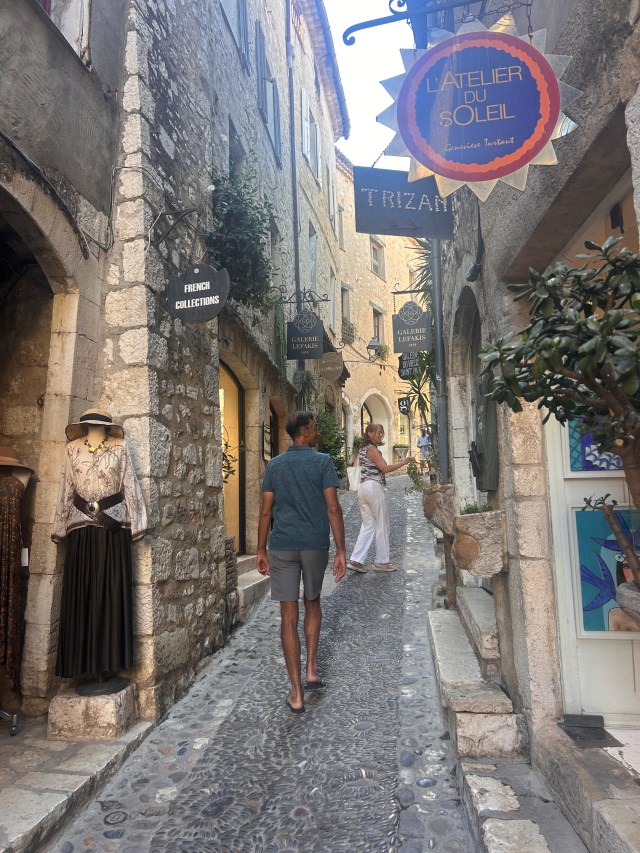
Earlier that afternoon, we’d wandered through Saint-Paul-de-Vence, following narrow stone streets between medieval buildings. I wondered how often Baldwin had walked these same corridors, stopping to greet someone he knew. Outside the ramparts, men played pétanque near Café de la Place. We passed La Colombe d’Or, the legendary hotel and restaurant where Picasso, Matisse, and other artists had gathered, sometimes exchanging paintings for meals.
Baldwin had been a familiar presence there, too. His biographer Jules B. Farber, in James Baldwin: Escape from America, Exile in Provence, recounts a waiter affectionately calling him “our Jimmy,” part of the restaurant’s extended family.
I loved the affectionate possessiveness of our Jimmy. But I still wanted to find the place he’d called home.
With a determination that exceeded my companions’ enthusiasm, I led us down the hillside.
What followed became our death march.
We doubled back, climbed another road, and reconsidered the directions. Sweat trickled down my back as I squinted at the map. Surely there would be a sign pointing toward the home of one of America’s greatest writers.
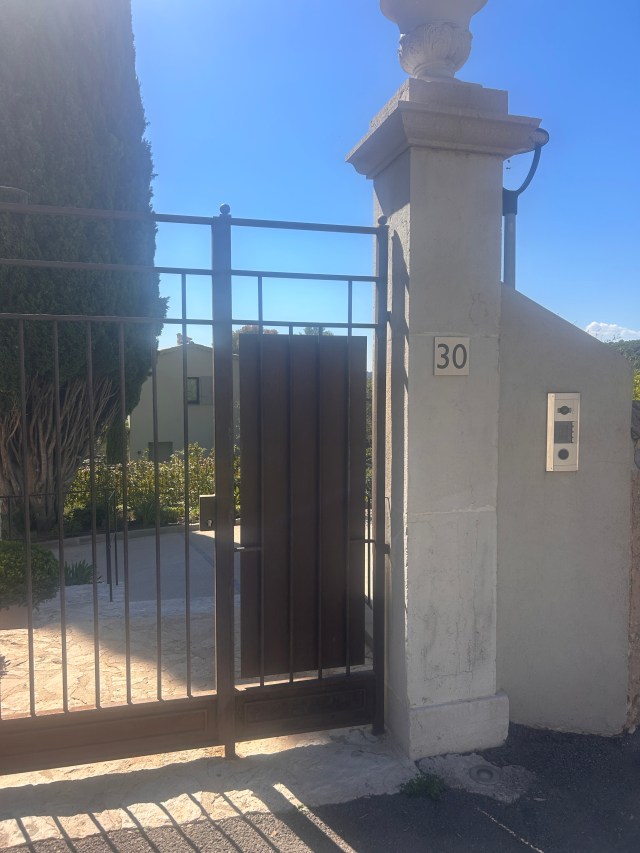
Instead, we finally arrived at a high wall and a gated entrance marked Le Jardin des Arts.
Number 30. An intercom. A private entrance. No Jimmy.
Much of Baldwin’s old stone farmhouse had been demolished to make way for luxury residences. We’d found the address, but almost nothing of the home I’d traveled thousands of miles to see.
I stood outside the gate, disappointed. What had I expected? That someone would invite us in? That I might glimpse his writing desk through a window or sit beneath the trees where he’d entertained his friends?
I’d come looking for a house. But what was I really hoping to find?
James Baldwin knew something about the difficulty of finding a home.
Born in Harlem in 1924, he grew up confronting the limitations imposed on Black Americans. At twenty-four, he left for Paris, seeking enough distance from America’s racial oppression to discover himself as a writer and a man.
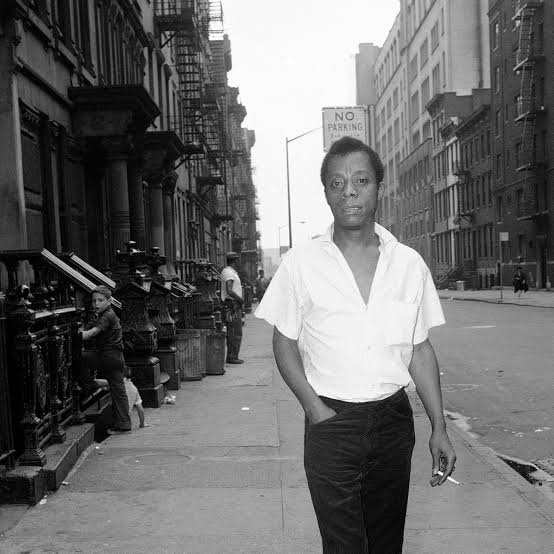
France offered possibilities, but it didn’t erase the complexities of race, sexuality, or exile. Baldwin continued moving between Europe and America, confronting his country’s injustices even while living abroad.
His writing explored the struggle to live honestly in a world that often demands otherwise. In Giovanni’s Room, an American expatriate in Paris falls in love with an Italian man but cannot reconcile his desires with the conventional life he imagines for himself. Their room shelters intimacy but cannot protect them from shame and fear.
I wondered about the difference between having a room of one’s own and finding a place where one could truly be oneself.
For Baldwin, the need for refuge became urgent.
The assassinations of his friends Medgar Evers, Malcolm X, and Martin Luther King Jr. devastated him. In a 1987 interview with Architectural Digest, Baldwin recalled how King’s death shattered his world. Exhausted by years of political engagement, travel, and grief, he suffered repeated physical collapses. Friends helped him recover in the South of France.
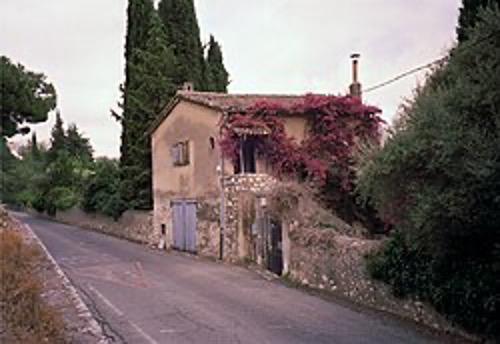
Eventually, he settled into an old stone farmhouse beneath Saint-Paul-de-Vence. What began as a temporary refuge became his permanent home in 1971.
The house overlooked the valley, with a studio adjoining a terrace and enough space to accommodate guests. Here Baldwin could recover, write, and withdraw from the demands of public life.
I understood the appeal.
Back in San Francisco, I cherish the quiet of my apartment. I love mornings spent reading, writing, or thinking without interruption. Silence, for me, is not emptiness. It is nourishment.
Milan and I have been searching for a home to share. My wish list begins with sunlight, windows, and above all, stillness. I imagine a place where the world grows quiet enough for me to settle into my own rhythms.
Baldwin, too, valued solitude. A Smithsonian exhibition about his Saint-Paul home describes the secluded study where he spent long hours at his typewriter.
Yet photographs of his household complicate my vision of sanctuary.
There are people everywhere.
Baldwin’s home, known as Chez Baldwin, was not merely a writer’s retreat. It was a gathering place.
Friends, relatives, artists, and musicians came to stay, sometimes for extended periods. His companion Bernard Hassell helped sustain the household. The painter Beauford Delaney, an important influence on Baldwin’s artistic life, spent time there. Visitors included Nina Simone, Maya Angelou, Josephine Baker, and other celebrated figures, alongside friends whose names would never appear in literary histories. They ate, drank, argued, laughed, listened to music, and talked long into the night.
At the center of this life was a table.
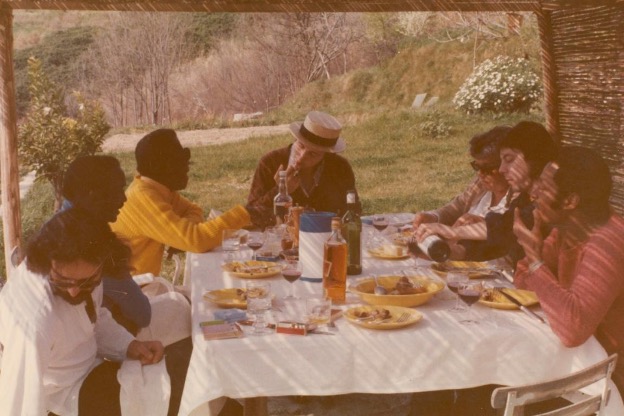
In one photograph, Baldwin sits with friends around an outdoor table beneath a shaded terrace. Plates, bottles, and glasses crowd the white tablecloth. Beyond them stretches the countryside. Here was another Jimmy: not standing before an audience or confronting America’s injustices, but sitting among friends, sharing a meal.
Reading Farber’s accounts of the people who knew him, I began to imagine his presence at that table. Friends remembered his enormous, raucous laugh and his affectionate habit of calling people “baby.” When a young writer named Cecil Brown failed to receive a fellowship, Baldwin offered him something else: an invitation to come share a pork chop.
But Jimmy’s hospitality had limits. According to another guest, when a man at dinner argued that Vietnamese refugees should be sent back, Baldwin became furious and told him he would never be invited again.
Here was a more complicated Jimmy: funny, generous, and unwilling to tolerate injustice, even at his own table. I wished I could pull up a chair and get to know him.
The table had a name: the welcome table.
The phrase evokes the African American spiritual “I’m Gonna Sit at the Welcome Table,” a promise of dignity and belonging rooted in the experience of racial exclusion. During the Civil Rights Movement, the song also became associated with the struggle to desegregate lunch counters.
For Baldwin, a Black gay man who had confronted exclusion throughout his life, welcome meant far more than hospitality. His table offered companionship, conversation, and a place where people could gather across differences.
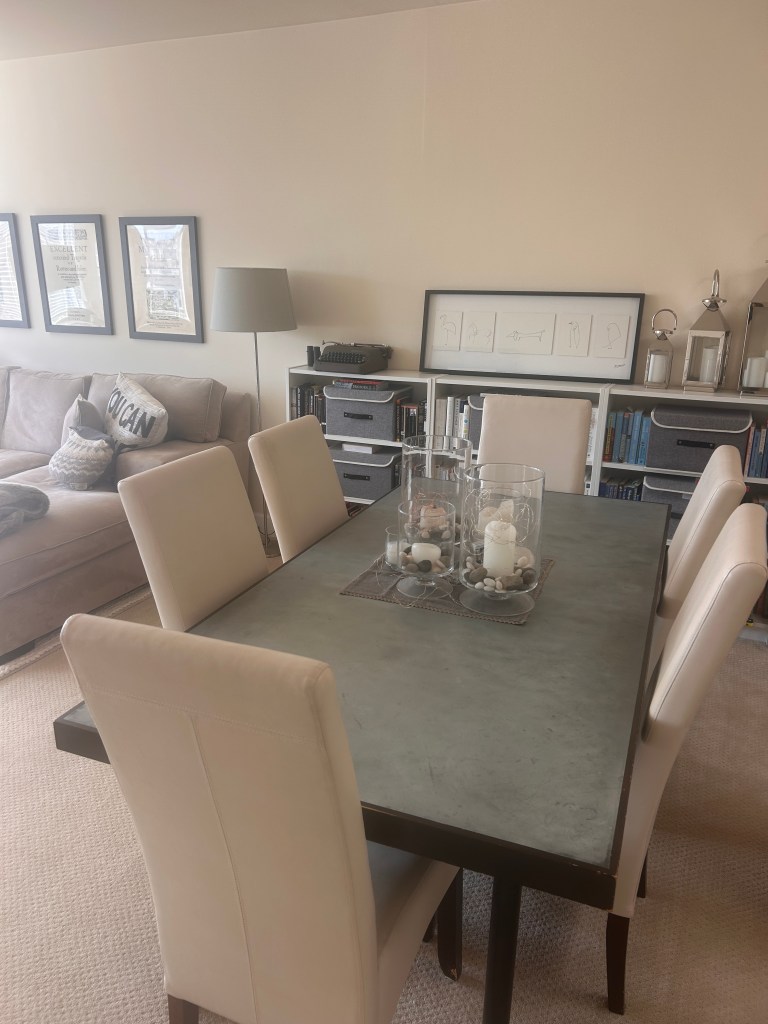
I have a dining table large enough for six people, although most evenings I eat alone.
Lately, I’ve been making room for Milan.
When he comes over, we sit at adjoining sides of the table, close enough to hold hands. Books often spark our conversations. David Brooks’s How to Know a Person might leave us wondering how well we can ever understand another human being. Thich Nhat Hanh’s Living Buddha, Living Christ invites us to explore the common ground between my appreciation for Buddhist teachings and Milan’s background in Christian theology. Sometimes our dinner plates remain between us long after we’ve finished eating.
For all the pleasure I take in these evenings, entertaining a crowd in my own home has never come easily. I worry about the food, the arrangements, whether everyone is comfortable. Gathering around someone else’s table is much easier.
Baldwin’s house made me wonder whether I’d imagined sanctuary too narrowly. It had accommodated the solitary writer and the generous host, the private man and the public intellectual. Could ours do the same?
As Milan and I prepare to share a home, we’re bringing two established lives into a new arrangement. My books, photographs, furniture, and the objects I’ve collected over a lifetime reflect my history. Milan brings his own possessions and memories. Now we’re figuring out how to combine them, including where to put that dining table.
Reflecting on the continual repairs his old stone house demanded, Baldwin observed that “one can never suppose one’s work is done.”
Maybe our home would continue to evolve with us, honoring who we’d been while making space for who we wanted to become.
Five days after our unsuccessful pilgrimage, we returned to Saint-Paul-de-Vence.
This time, nobody was consulting a map.
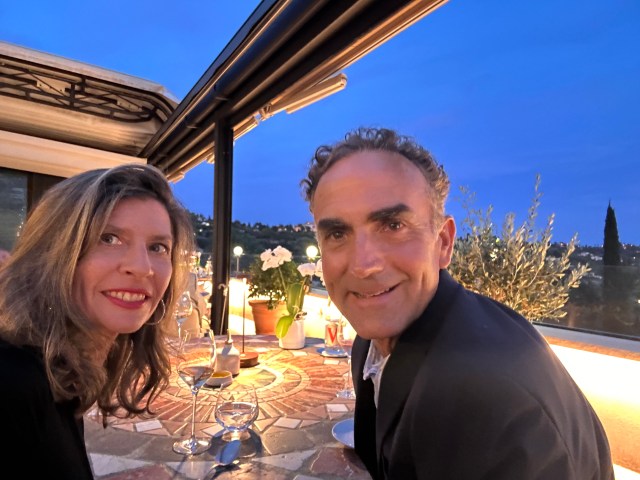
Milan and Kimberley had arranged a birthday dinner at Alain Llorca, a restaurant overlooking the medieval village, much as Baldwin’s house once had. Instead of trudging along the hillside, we sat at a circular mosaic table adorned with white orchids.
A waiter poured champagne. Courses arrived on white plates. As the sun disappeared, lights began appearing in the village windows. On my finger was the pale pink ring Milan and I had chosen in Èze the day before.
Five days earlier, I’d dragged these same companions up and down the hillside searching for a vanished house. Now, seated at what felt like the most beautiful table in Provence, I was grateful for the man beside me, the friend who had shared the journey, and another birthday in a country I loved.
I’d come looking for Jimmy, hoping his home might bring me closer to understanding him. Instead, I’d discovered someone far more complicated than any house could contain.
How can we ever completely know another person, or even ourselves?
Perhaps the gift was in the seeking, room by room.
Milan and I were still searching for a home of our own. I didn’t know where we’d find it or how many people might gather around our table. But I liked imagining a place where we could keep discovering one another, making room for all the people we were still becoming.
Further Reading
- “Chez Baldwin.” National Museum of African American History and Culture, Smithsonian Institution, https://nmaahc.si.edu/explore/exhibitions/chez-baldwin. Accessed 21 Oct. 2026.
- Farber, Jules B. James Baldwin: Escape from America, Exile in Provence. Pelican Publishing, 2016.

- James Baldwin: The Price of the Ticket. Directed by Karen Thorsen, produced by Karen Thorsen and William Miles, Nobody Knows Productions and Maysles Films, 1989.

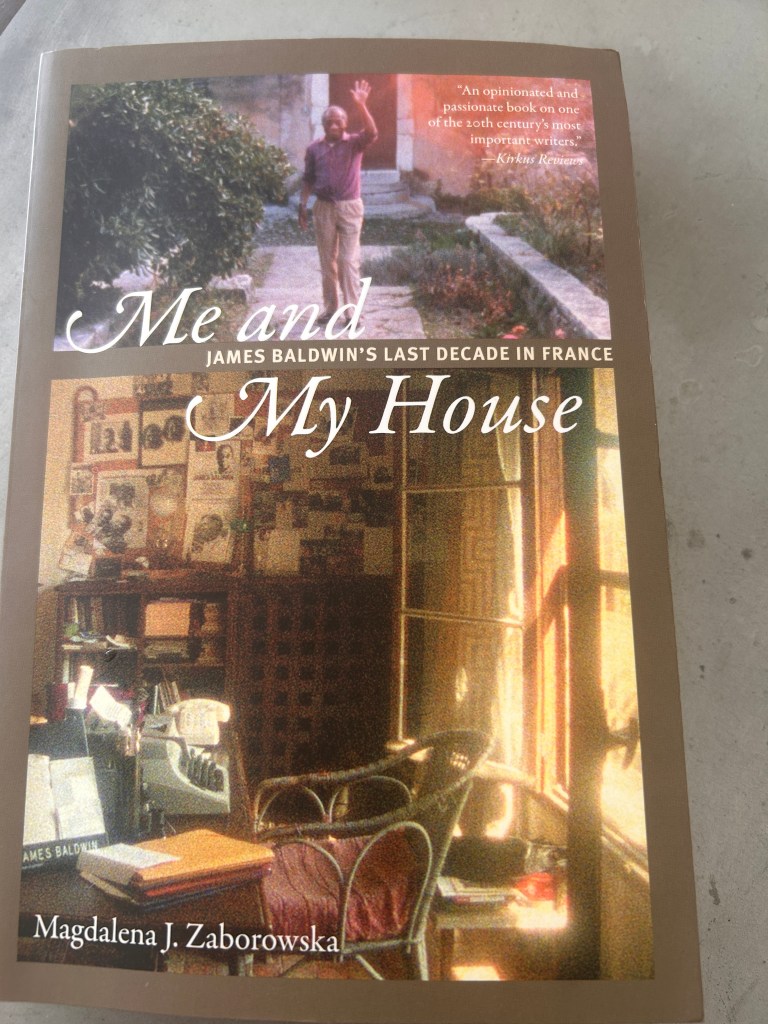
- Zaborowska, Magdalena J. Me and My House: James Baldwin’s Last Decade in France. Duke UP, 2018.
In James Baldwin’s Words
“You think your pain and your heartbreak are unprecedented in the history of the world, but then you read. It was books that taught me that the things that tormented me most were the very things that connected me with all the people who were alive, who had ever been alive.”
― James Baldwin, Giovanni’s Room“Perhaps home is not a place but simply an irrevocable condition.”
― James Baldwin, Giovanni’s Room“You don’t have a home until you leave it and then, when you have left it, you never can go back.”
― James Baldwin, Giovanni’s Room“You write in order to change the world … if you alter, even by a millimeter, the way people look at reality, then you can change it.”
― James Baldwin“Love has never been a popular movement. And no one’s ever wanted, really, to be free. The world is held together, really it is held together, by the love and the passion of a very few people. Otherwise, of course, you can despair. Walk down the street of any city, any afternoon, and look around you. What you’ve got to remember is what you’re looking at is also you. Everyone you’re looking at is also you. You could be that person. You could be that monster, you could be that cop. And you have to decide, in yourself, not to be.”
― James Baldwin


Jules! Another golden piece!
I love that the table made it into the story! Can’t wait to sit around it in your and Milan‘s new home.
I love how you are weaving together your life with these writers’ lives in such a beautiful way.
Love, e
Erin Byrne erinbyrnewriter.com
Grand Prize Solas Awards for Travel Story of the Year Lowell Thomas Award, Society of American Travel Writers Foundation
LikeLike