There is something delicious about writing the first words of a story. You never quite know where they’ll take you. ― Beatrix Potter
It happened again last night. Around four in the morning, in that porous hour where the mind has loosened its grip, I woke to find my mother sitting at the end of my bed. I wasn’t afraid. Her presence felt soft, familiar, as if she had traveled from some other room rather than from the other side of death. In the dark she appeared only as a round silhouette, her back curved slightly as though she were simply keeping watch.
I closed my eyes, and a moment later felt the faintest stroke along my forearm. My mother’s warm palm, the one I’ve missed for five years now. She didn’t speak, but her message was unmistakable: I’m here.
These nighttime visitations began shortly after I started writing more intensely. Six weeks of sustained creative focus seemed to open something in me, something both ancient and new. I have felt, more and more, that I’m standing between two worlds: one foot on earthly ground, the other in some imaginal field. And I am beginning to wonder whether this liminal sensitivity, this opening, is not just a byproduct of grief or imagination, but a kind of perception.
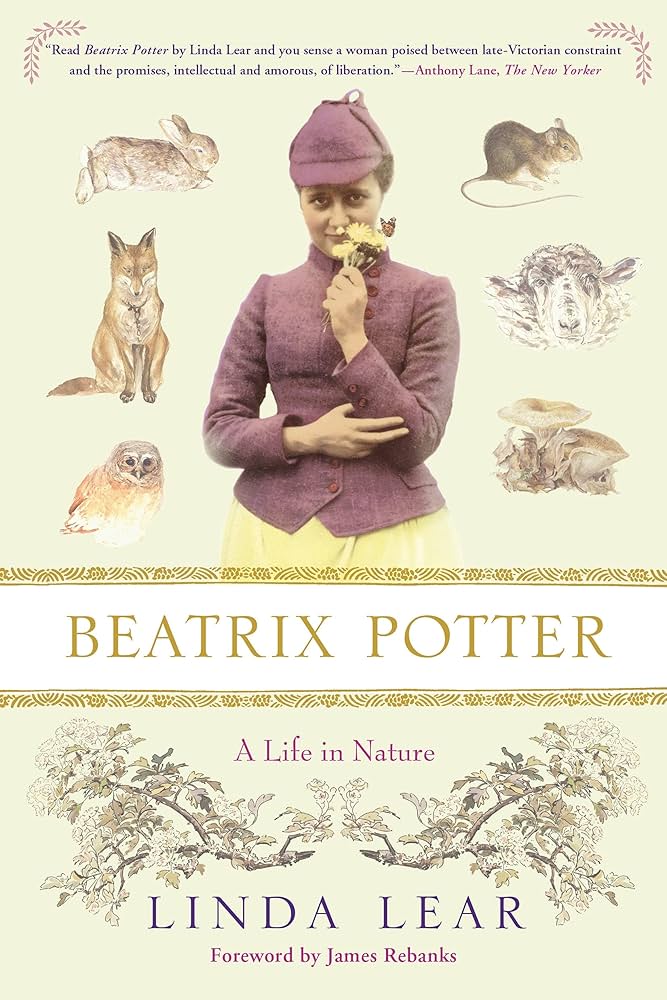
Perhaps that is why Beatrix Potter, a kind of seer herself, keeps rising in my thoughts. I visited her Hill Top home in the Lake District this past September, thinking it was simply part of my sabbatical research, yet something in those rooms stayed with me, a recognition I could not name at the time.
A Childhood Lived on the Threshold
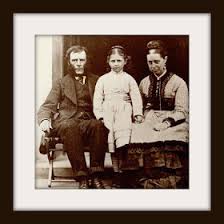
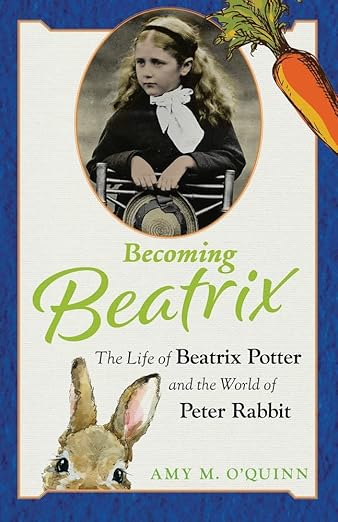
Beatrix grew up in Kensington, London, in a Victorian home full of high collars and proper posture. Her mother, rigid about class and appearance, kept her upstairs in the nursery with her governess for most of her childhood. In those shuttered rooms, the smallest details became worlds: a patch of sky beyond the window, the pet rabbit nibbling at her sleeve, the mice skittering in the walls. Her beloved rabbit, Benjamin Bouncer, sometimes sat at her tea table with a napkin folded beneath his chin. She spoke to him in that earnest way children do when they believe the world is listening back. “Thank goodness I was never sent to school,” she later wrote. “It would have rubbed off some of the originality.” Before her brother Bertram was born, she was already staging miniature dramas in her mind—rabbits, hedgehogs, cats, and frogs moving with more freedom and feeling than the stuffy adults below stairs.
Thinking of Beatrix in that nursery reminded me of my own sister. Gina was 5 when I was born, the same age Beatrix was before Bertram arrived. My sister was the most imaginative person I knew, staging living-room plays, writing stories about our cat Genie, telling me about the gnomes and fairies in the trees. I used to think she was magical. And maybe she was. Seeing a world adults had forgotten.
What struck me later was that Beatrix’s imagination didn’t fade as she grew; it simply became more deliberate. She wrote that she “half believed and wholly played with fairies,” not as an escape, but as a way of staying close to the world beneath the world. I imagined her tucked away upstairs, half in her body, half in that deeper elsewhere—a realm she entered by paying close attention to fur, whiskers, twitching paws. Her imagination wasn’t a departure from reality but a way of seeing more of it.
And perhaps this is where the line between her world and mine began to blur.
Because lately, in that same liminal space she inhabited, I too have begun to sense a world revealing itself.
Creativity as a Living Portal
The writer Elizabeth Jarrett Andrew says that creativity isn’t a one-way channel from writer to page, but “radial — influencing everyone in its proximity… a conversation between self and source.”
This is exactly how it has felt lately. Not like I am simply writing my stories, but like I am listening to them. Listening to my mother. Listening to the women whose houses I visit: Jane Austen at Chawton, the Brontë sisters at Haworth, Dorothy Wordsworth at Grasmere. Their devoted lives seem to echo through mine, as if the work of writing is tuning me to some frequency they once inhabited.
And so, when I traveled north with my sister on a rainy afternoon toward Beatrix Potter’s home in the Lake District, it wasn’t just a literary pilgrimage. It felt like another opening into the unseen where imagination gathers its forces.
The Lake District: Her True Home
Beatrix discovered her true self in the wild, wet fells of Cumbria County, where her family came each summer. I visited Wray Castle first, the place she stayed at sixteen, now closed for renovations but still commanding the hillside above Lake Windermere.
My sister and I walked the grounds through sodden woods and dripping leaves, past a small church with rain beading on its steeple. The trail sloped toward the water, the earth soft under our boots. The whole day felt sloshy and mossy, exactly the kind of weather that must have fed Beatrix’s early obsession with mushrooms.
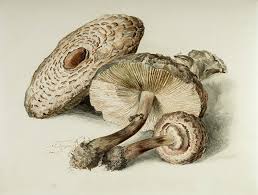
That’s right. Long before Peter Rabbit, she sketched fungi with near-scientific devotion. Turkey tails, chanterelles, shaggy manes, each penciled with the gills, spores, and delicate ribs hidden under the cap. She saw patterns most people never noticed. The mycelium threading underfoot. A quiet exchange happening beneath the soil.
I tightened the cords of my rain hood. My focus narrowed. I could almost picture her crouched on the forest floor, magnifying glass in hand, studying a mushroom’s underside like she was listening to it.
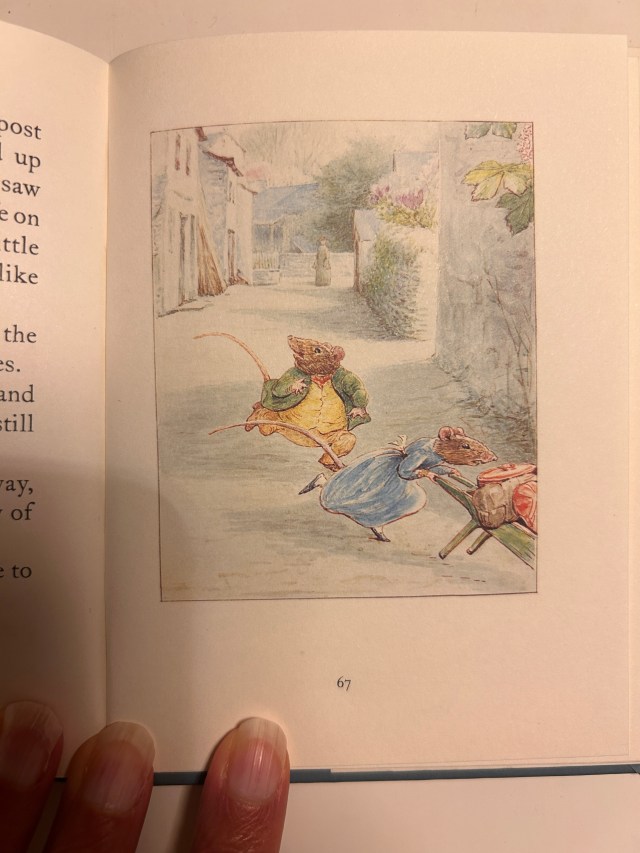
Inside the small library near the castle, we bought two of her books: The Tale of the Pie and the Patty Pan and The Tale of Samuel Whiskers. A volunteer mentioned a detail in the second book on page 87. When we turned to it, we saw her — Beatrix — painted faintly into the background. Almost an apparition. As if she had slipped into her own story, a quiet reminder that she lived inside everything she created, and maybe still lingers in these hills she loved.
Hill Top: Entering the Storied House
From Wray Castle, we drove to the tiny village of Sawrey, a cluster of stone cottages gathered around one pub and the house Beatrix loved most: Hill Top Farm. Even in the rain it glowed. A two-story stone house with climbing vines and pink curtains, standing at the edge of its garden like it had been waiting for us.
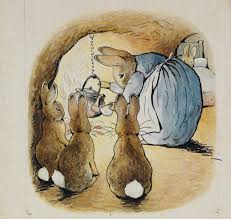
We ducked under the gabled doorway and entered a parlor, warm, dim, wood-paneled, a small fire crackling in the hearth. On a round table near the embers lay a book opened to a page from The Tale of Samuel Whiskers. The illustrated cat in her apron seemed very much at home, and for a moment I wondered if she were waiting to serve us tea.
Beatrix had bought Hill Top after the sudden death of her fiancé, Norman Warne. She had imagined living here with him. Instead, she arrived alone. But the place claimed her. Though she spent much of the year in London, Hill Top became her refuge, a sanctuary where she could draw, write, and walk the lanes in solitude. So many of her tales grew out of this house and this village that the rooms feel less like the source of her stories and more like the places where she overheard another world. As she once wrote, “I remember every stone, every tree, the scent of heather… Even when the thunder growled in the distance, and the wind swept up the valley in fitful gusts, oh, it was beautiful, home sweet home.”
In the dining room, polished plates and floral teacups sat arranged as if Mrs. Tiggy Winkle or Jemima Puddle-Duck might return at any moment. Upstairs, the floors creaked with centuries of footsteps. In a bedroom, a guide with encyclopedic knowledge and a touch of elfin lightness revealed Beatrix’s inner life: her precision, her solitude, her fierce attention to the overlooked. “She was a collector,” he said, gesturing toward tiny ceramic animals and doll-sized furniture. “Miniatures, mushrooms, beetles, stories. She could live inside the smallest of worlds.”
He stopped and looked at me. “You know… I wonder if she didn’t have a touch of autism. Same as me. It’s why she could zero in on things, see stuff other people walk right past.”
I paused at his words. It didn’t feel like a diagnosis but a recognition: that Beatrix belonged to another frequency of perception, one reached through solitude, one that made her attuned to texture, movement, the inner lives of creatures others dismissed.
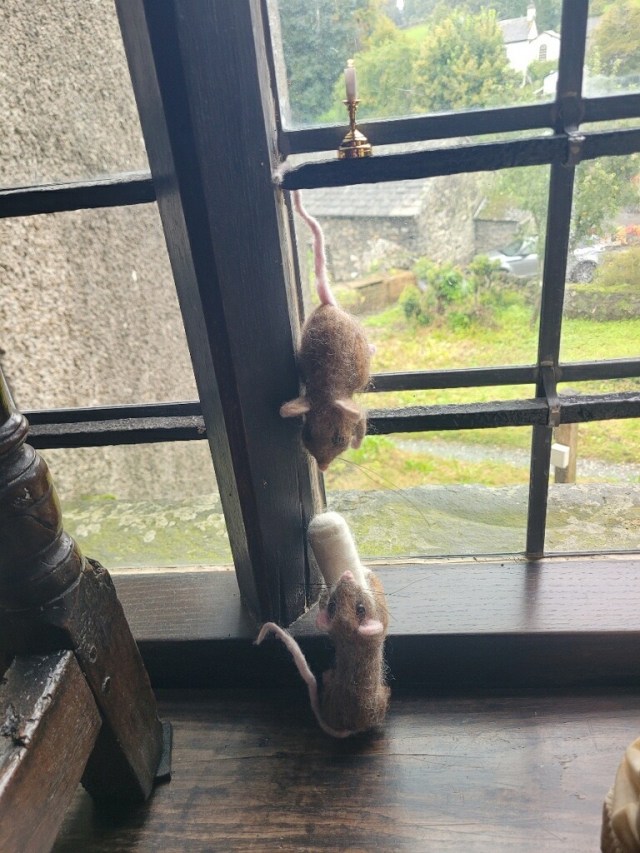
As the guide spoke, I noticed two felt mice climbing the windowsill, their stitched paws poised as if mid-scamper. He had just told us that when Beatrix moved into Hill Top, the house held nearly eight dozen mice. Most people would have set traps. She gave them names – Samuel Whiskers, Anna Maria, Tom Kitten’s mischief-makers. She wrote them into stories. She let them stay.
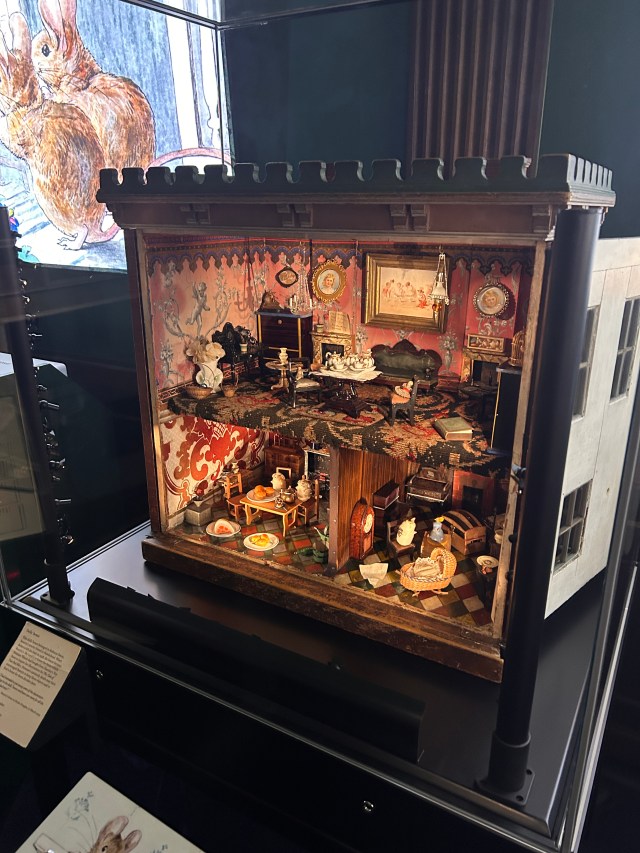
Later, downstairs, the dollhouse she filled with her own handmade miniatures glowed behind glass. Tiny carpets, thumb-sized books, chairs waiting for someone small to rest in them. It struck me that she didn’t banish what unsettled others; she made it a home. A world. A place with rooms and beds and stories.
Something in that felt familiar. Maybe what we fear doesn’t always need to be pushed away. Sometimes it asks to sit beside us. To be seen. To be folded into the story we’re already living.
Back to the Land
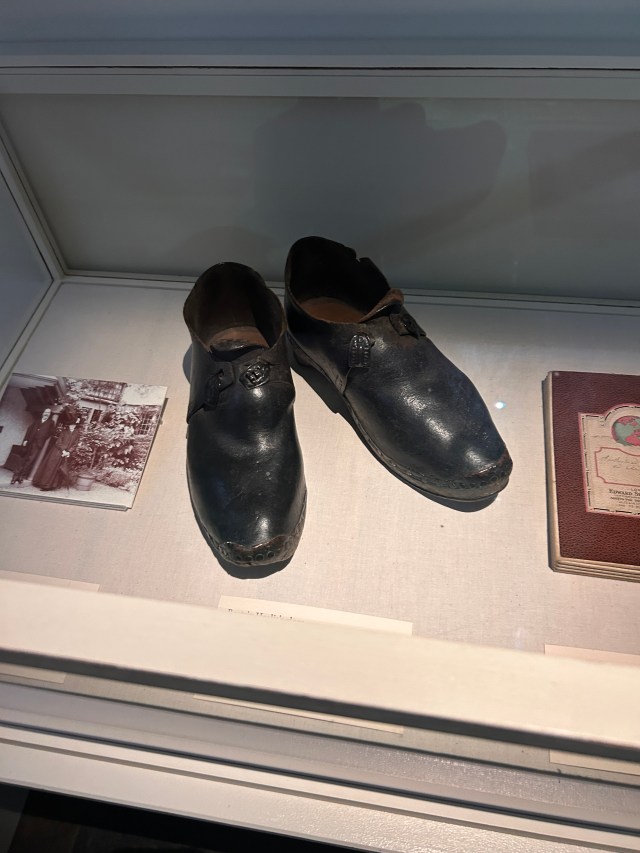
As I made my way toward the exit, I passed a small mud room where a pair of Beatrix’s shoes rested in a case. Black, sturdy, weather-worn at the toes. Outside, the garden opened around me, and I imagined those soles on the ground as she planted herbs, pruned apple trees, tended her Herdwick sheep.
My mother would have loved Hill Top farm. The honest ground, the quiet rhythms, the open sky. She once dreamed of being a forest ranger or a cowgirl, raised chickens in our backyard,and always seemed most herself in the fresh air. She belonged to her places too. To the beaches she walked, the lakes she loved, the quiet corners of earth that steadied her.
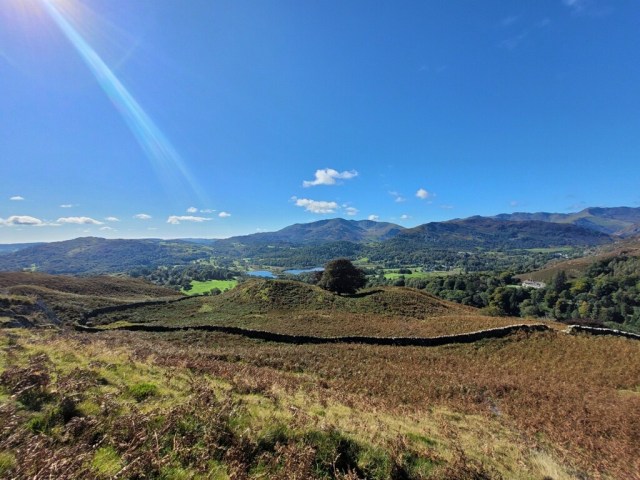
Beyond the hedges, the view widened into pasture and stone-walled acreage, the land Beatrix devoted her later years to protecting. Her ashes were returned somewhere out here; only one person knows where. My mother’s ashes are scattered too, across the landscapes she cherished.Both women returned to the earth in quiet ways.
Standing on that hill, I took in the long sweep before me. The stitched boundaries, the curves of the uplands, the house tucked behind. Just earth and sky and distance.
And now, in this deep stretch of writing, I find myself returning to that rise where something seems to open.
“Believe there is a great power silently working all things for good, behave yourself and never mind the rest.”
“I hold that a strongly marked personality can influence descendants for generations.”
“What heaven can be more real than to retain the spirit-world of childhood, tempered and balanced by knowledge and common-sense.”
“Thank God I have the seeing eye, that is to say, as I lie in bed I can walk step by step on the fells and rough land seeing every stone and flower and patch of bog and cotton pass where my old legs will never take me again.”






 Julie Pesano